Monthly Bookkeeping

Books That Close on Schedule, Every Month.

Monthly bookkeeping for construction, real estate, and property-management businesses: transaction categorization, reconciliations, and agreed financial reports in QuickBooks Online. Entirely remote, nationwide, from Lake Stevens, Washington. The problem is rarely that nobody is doing the bookkeeping; it is that the month never actually closes, so the numbers stay provisional. A monthly cycle fixes the calendar first and the numbers follow.

  • 30 minutes
  • Complimentary
  • By video
  • No obligation

A close date you can plan around Every account reconciled first A statement package each month

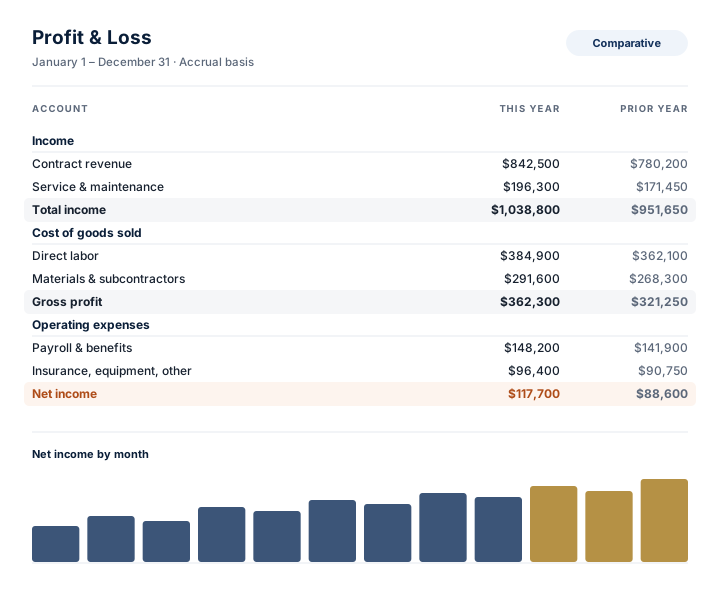
PROFIT & LOSS · MONTHLY PACKAGE
Illustrative profit and loss statement comparing this year and prior year across income, cost of goods sold, gross profit, operating expenses, and net income, with a monthly net income trend.
  • QuickBooks ProAdvisor Gold
  • 10+ Years Finance Systems Experience
  • Secure Cloud Bookkeeping
  • Serving Clients Nationwide
The Problem

Provisional Numbers Are Expensive

When the books are never formally closed, three things happen, and none of them look like a bookkeeping problem from the outside.

You stop trusting the reports. A Profit and Loss that might change next week is not something you will price a job from, or take to a lender, or use to decide whether you can afford another truck.

You start keeping a second set of numbers in your head, or in a spreadsheet. That shadow copy is the one you actually run the business on, and it is the one nobody else can see or check.

And the work compounds. A missed reconciliation in March is a small correction. Found in November, it is eight months of downstream categorization to unpick, usually right when your CPA is asking for the year.

None of that is solved by working harder inside the file. It is solved by having a cycle: the same sequence of steps, in the same order, finishing on the same date.

How It Runs

The Same Sequence, Every Month

Reconcile first, categorize second, review third, close fourth. The order matters: categorizing before the bank ties out means categorizing transactions that may not be real yet.

  1. 1

    Reconcile every account

    Bank accounts, credit cards, and loans are reconciled to the statement, not to the bank feed. A feed that has imported cleanly can still be missing a week nobody noticed.

  2. 2

    Categorize against a chart of accounts that means something

    Costs land where the decision needs them: on the job, the property, or the entity. Bank rules do the repetitive part, and anything ambiguous comes to you as a short question rather than a guess.

  3. 3

    Work the open items

    Accounts receivable and accounts payable are brought current, uncleared items are chased, and balance sheet accounts are checked for the balances that quietly stop making sense.

  4. 4

    Review, report, and close the period

    You get the statement package and a short plain-language note on what changed and what needs your attention. Then the period is closed with a closing date set, so it stays closed.

A closing date is the unglamorous part that makes the rest hold. Without it, a corrected prior month silently changes the report you already made a decision from.

Scope

What Is In, and What Is Not

Every engagement is scoped in writing before it starts, so the boundary is agreed rather than assumed.

What this service may include

  • Reconciliation of bank, credit card, and loan accounts
  • Transaction categorization against your chart of accounts
  • Accounts payable and accounts receivable upkeep
  • Payroll entries recorded from your payroll provider reports
  • Chart of accounts organized around your industry and your decisions
  • Balance sheet review, including the accounts that drift quietly
  • A monthly statement package with a short written summary
  • Period close with a closing date set in QuickBooks Online
  • A year-end package your CPA or tax professional can work from

What sits outside the scope

  • Tax preparation and tax filing of any kind
  • Tax, legal, audit, or investment advice
  • Running payroll as a licensed payroll provider
  • Filing or remitting payroll tax returns
  • Audited or reviewed financial statements
  • Signing checks, initiating payments, or moving money

Meridian Ledger Group LLC provides bookkeeping, payroll support, and financial reporting. It does not provide tax, legal, audit, or investment advice, and does not prepare or file tax returns.

Outputs and Inputs

Your Monthly Package and the Records Behind It

The package is agreed in writing during onboarding, and each month’s version depends on the records that come in.

Agreed Monthly Outputs

  • Profit & Loss and Balance Sheet for the period
  • Reconciliation status for each account in scope
  • Open questions and items awaiting your answer
  • A short plain-language summary of the month

Cash-flow views, AR and AP aging, and job, property, or entity breakdowns are added where the written scope includes them and the records support them, so not every package carries all of them. Financial reporting explains how these reports read. Forecasting and other fractional CFO advisory work is scoped separately and is not automatically included.

What Meridian Needs From You

  • Complete bank, credit-card, and loan statements
  • Receipts, invoices, and bills
  • Payroll-provider reports, if payroll is in scope
  • Coding information for jobs, properties, or entities
  • Timely answers to questions, and owner approvals

Login passwords are never requested through a form. Access is arranged with you directly during onboarding.

The close and report date is agreed during onboarding, based on when your documents are usually available and how complex the file is. Late or incomplete inputs can change that month’s timing, and there is no universal day-of-month guarantee or response-time commitment. Books that are already behind are brought current first under a separate cleanup and catch-up scope.

Who It Suits

This Is a Good Fit If

  • You are already on QuickBooks Online, or willing to be.
  • You want the same reports on the same date, not on request.
  • You need profit read by job, property, or entity rather than one company total.
  • Your CPA has asked for cleaner records, or you would rather they never had to.
  • You would rather hand the whole cycle over than supervise it.

If the books are months behind, start with cleanup and catch-up instead. A monthly cycle built on unreconciled history inherits every problem in it.

Start Here

Find Out What Your Close Is Missing

Thirty minutes, by video, at no cost. Bring a recent Profit and Loss or nothing at all, and you will leave knowing which part of the monthly cycle is actually breaking.

  • 30 minutes
  • Complimentary
  • By video
  • No obligation

Mon to Fri, 9:00 AM to 5:00 PM Pacific Lake Stevens, WA. Working virtually nationwide.

Questions

Monthly Bookkeeping FAQ

How long does the monthly close take?

The statement package is scheduled for a date agreed during onboarding, based on when your bank, credit-card, loan, and payroll records are usually available and how complex the file is, so you can plan around it. There is no universal day-of-month guarantee, and late or incomplete records can move that month’s date.

What reports are included in monthly bookkeeping?

Each month’s agreed package includes a Profit & Loss and Balance Sheet for the period, the reconciliation status of each account in scope, open questions or items, and a short plain-language summary. Cash-flow views, AR and AP aging, and job, property, or entity breakdowns are included where the written scope calls for them and the records support them. CFO forecasting and advisory work is scoped separately.

What records do you need each month?

Complete bank, credit-card, and loan statements; receipts, invoices, and bills; payroll-provider reports if payroll is in scope; coding information for jobs, properties, or entities; and timely answers to questions and owner approvals. Login passwords are never requested through a form.

How are the monthly scope and fee determined?

By transaction volume, the number of accounts and entities, and the tracking and reporting the business needs, such as job, property, or entity detail. Scope and fee are agreed in writing before the engagement starts. If the books are behind, bringing them current is quoted as a separate cleanup scope rather than folded into the monthly fee.

Do you need access to my bank accounts?

No. Read-only bank feeds inside QuickBooks Online or statement copies are enough. Meridian does not need banking login credentials and does not initiate payments or move money.

What if a month has almost no activity?

It still gets reconciled and closed. A quiet month is the cheapest month to keep clean, and a gap in the reconciliation history is what makes a later cleanup expensive.

Can you work with my existing chart of accounts?

Yes, and the first step is usually to review it rather than replace it. Where the structure cannot answer the questions you are asking, the change is proposed, explained, and agreed before anything is reorganized.

Do you prepare or file my taxes at year end?

No. Meridian does not prepare or file tax returns. What you receive is a reconciled year-end package that your CPA or tax professional can work from directly.

What happens if I want to stop?

The books are yours. QuickBooks Online stays in your name and under your ownership throughout, so there is nothing to migrate or extract if the engagement ends.


Book a Review Book Now