
Job profit is a guess
Costs land in one company-wide bucket. You can see that revenue came in, but not which project earned it or which one quietly ate the margin.

Bookkeeping structured around how construction businesses run: costs tracked to the job that incurred them, subcontractor payables organized, and payroll support that keeps up with the crew schedule.
A free 30-minute review of how your jobs, costs, change orders and retainage are actually recorded.
Job-level costing Subcontractor & 1099 records Retainage tracked separately
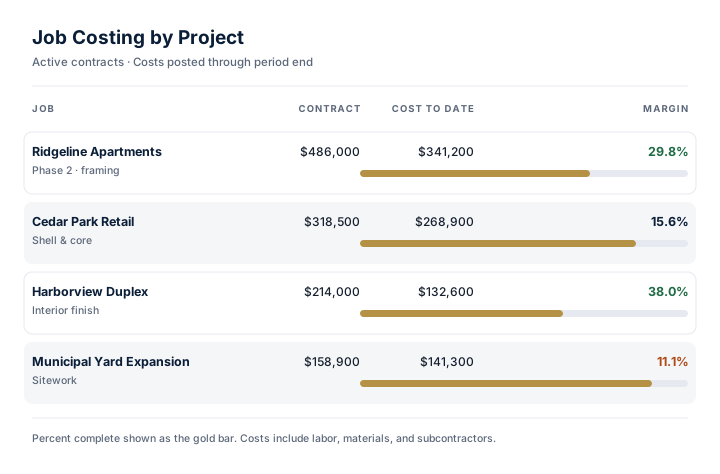
Construction has cost structures that general bookkeeping is not built for. Left alone, these compound quietly until a job closes in the red.
Costs land in one company-wide bucket. You can see that revenue came in, but not which project earned it or which one quietly ate the margin.
Withheld amounts get folded into general receivables and payables, so nobody can say how much is being held on which contract or when it should come back.
Payments across several active projects, missing W-9s, and vendor names entered three different ways. Come January, 1099 information has to be reconstructed.
Crew hours are paid but never mapped back to jobs, so labor, usually the largest variable cost on a project, is invisible in job reporting.
Extra work gets performed, sometimes invoiced, sometimes not. The original contract value and the actual billed value stop matching.
No projects or classes, a chart of accounts that grew by accident, and materials, equipment, and overhead all landing in the same expense line.
Most contractor files are organized around whatever the bank feed suggested. That is why the profit and loss looks fine and the job margins are a mystery. We rebuild the structure so every dollar has a job attached to it before it ever reaches a report.

Every piece is structured around the workflows a construction business runs on daily.
Scope of services: Meridian Ledger Group LLC provides bookkeeping, payroll support, QuickBooks Online services, and financial reporting. We do not provide tax preparation or tax filing, and we do not provide legal, tax, audit, or investment advisory services. We keep 1099 and job cost records organized so your CPA or tax professional can work from them directly.
Revenue, cost, and margin for every active and closed job. Answers: which work is worth bidding again, and which client relationships cost more than they return.
Estimated versus incurred cost while the job is still running. Answers: is this project drifting, and is there still time to do something about it.
What is owed to which subcontractor, against which job, and for how long. Answers: what has to go out this week and what can wait for the next draw.
Cash on hand alongside retainage held and owed. Answers: whether you can take on the next job without financing the gap yourself.
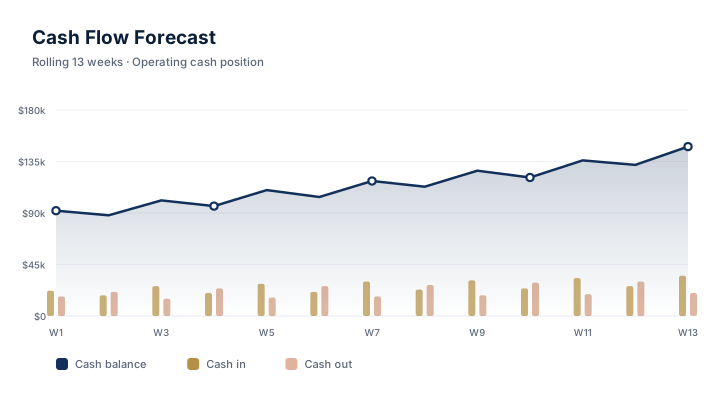

Draw schedules, subcontractor payments, and payroll all compete for the same cash. A thirteen-week view puts the crew schedule and the collection calendar on the same page, so the decision to take on the next job is made with numbers rather than optimism.
If the file is too far behind to report from, start with cleanup and catch-up
Thirty minutes with a QuickBooks ProAdvisor Gold, reviewing your file, your job setup, and your payroll process. No cost, no obligation, and the recommendations are yours to keep.
Mon–Fri, 9:00 AM – 5:00 PM Pacific Virtual, nationwide
Yes. QuickBooks Online is configured with projects or classes so labor, materials, equipment, and subcontractor costs post to the job that incurred them. That is what makes job-level profit and budget-to-actual reporting possible.
Yes. Subcontractor vendor records, W-9 tracking, and payment history are maintained throughout the year so 1099 information is organized and ready when your tax professional needs it. We do not prepare or file tax returns.
Yes. Retainage receivable and retainage payable are tracked in dedicated accounts so withheld amounts stay visible instead of disappearing into general receivables and payables.
Yes, as a defined cleanup and catch-up project with a fixed scope. See how cleanup and catch-up works, or book a health check and we will estimate the effort.
No. We do not provide tax preparation or tax filing, and we do not provide legal, tax, audit, or investment advisory services. We maintain accurate, reconciled books that your CPA or tax professional can work from directly.
A contractor can finish a job at a healthy margin and still not be able to make payroll, because in construction the money arrives long after the cost does. Margin reporting alone will never show you that.
On a job with progress billing, you buy material and pay labor in week one. You bill at the end of the month. The general contractor pays in thirty to sixty days, and holds back retainage until the whole project closes out. So the cash cycle on a profitable job can run four months longer than the cost cycle.
Stack three of those jobs and the company is financing its own growth out of working capital. That is survivable when it is visible and planned for. It is what kills contractors when it is a surprise.
A quarter is long enough to see a shortfall coming while there is still time to act on it: pull a draw forward, chase retainage, delay a purchase, or talk to the bank before the account is empty. It is also short enough that the numbers are real commitments rather than forecasts. Beyond about a quarter, a contractor’s cash view becomes guesswork about jobs that have not been awarded yet.
None of this requires new software. It requires the underlying records to be structured so the report can be produced, and someone to produce it on the same day every week.
Written for contractors who want to understand the mechanics rather than take our word for it. Construction gets the most detail here because it is where most of this work sits.

Entity and property-level books for investors, agents, and developers.
Real estate bookkeeping
Rent bookkeeping, owner distributions, and monthly reporting by property.
Property management bookkeeping
A fixed-scope project to bring a behind or disorganized file current.
Cleanup & catch-upReach a real person. No chatbot, no queue.
Monday–Friday, 9:00 AM – 5:00 PM Pacific.