
Reconcile every account, every month
Bank, credit card, and loan accounts. A reconciliation is the only routine check that proves your books match reality. If one month is skipped, the next one inherits the problem and the error gets harder to find.

Plain-English explainers on bookkeeping, QuickBooks Online, and financial reporting — written for owners of construction, real estate, and property management businesses.
No gated downloads. No email required. Nothing here is tax, legal, or investment advice.
None of these are difficult. They are simply the things that, when skipped for six months, turn into a cleanup project.
Bank, credit card, and loan accounts. A reconciliation is the only routine check that proves your books match reality. If one month is skipped, the next one inherits the problem and the error gets harder to find.
One business checking account and one business card. Owner draws and contributions belong in equity, not in expenses. Mixed accounts are the single most common reason a cleanup takes twice as long as expected.
Fifteen minutes a week beats four hours in April. Recent transactions are the ones you still remember; a receipt from nine months ago is a guess with a date on it.
QuickBooks Online lets you attach a receipt or invoice to the entry itself. When a CPA, a lender, or an insurer asks about a line, the answer is one click away instead of one afternoon away.
A chart of accounts with 300 lines is not detailed, it is unusable. Detail belongs in classes, locations, projects, and customers — dimensions you can filter — not in new expense accounts nobody remembers creating.
When a processor or a factor deducts its fee before depositing, record the full income and the fee separately. Netting them understates both revenue and expenses, and quietly distorts every margin you calculate.
Set a closing date in QuickBooks Online after each month is reconciled. Otherwise a stray edit to last year silently changes a report you already sent to a bank.
A Profit & Loss nobody opens is a filing exercise. Fifteen minutes a month comparing this month to last month is where bookkeeping starts paying for itself.
These two words get used interchangeably, and it causes real confusion about who you should be hiring — and what you should expect them to produce.
Bookkeeping is the record. It is the ongoing, disciplined work of capturing every transaction correctly: categorizing activity, reconciling accounts, tracking receivables and payables, handling payroll recordkeeping, and closing each month so the numbers stop moving. Bookkeeping answers what happened.
Accounting is the interpretation and the filing. It builds on the record to produce tax returns, formal financial statements, attestation work, and advice about structure and strategy. Accounting answers what it means and what must be filed.
They are sequential, not competitive. An accountant working from a poorly kept file spends billable hours doing bookkeeping before the accounting can start — which is why disorganized books usually show up as a larger invoice from your CPA rather than as a bookkeeping problem.
Where Meridian sits: we do the bookkeeping half. Bookkeeping, QuickBooks Online services, payroll support, and financial reporting. We do not provide tax preparation or tax filing, and we do not provide legal, tax, audit, or investment advisory services. We work alongside your CPA and hand them a file they do not have to repair first.
Meridian Ledger Group LLC performs the work in the left column only.
Construction is the industry where generic bookkeeping fails fastest, because the money moves on a job timeline and the bank feed does not know that.
Without a project or customer on every cost, you get one company-wide gross margin and no way to tell which job earned it. Every material purchase, subcontractor invoice, equipment charge, and labor hour needs a job attached at entry — retrofitting it later is guesswork.
A deposit received before work is performed is a liability, not revenue. Booking it as income inflates a good month and creates a hole in the month you actually do the work, which makes every trend line meaningless.
Retainage withheld is money you have earned but not yet collected. It belongs in a retainage receivable account, not written off against revenue. Otherwise your receivables understate what the business is owed, sometimes by a full month of profit.
Approved in a text message, executed on site, invisible in QuickBooks. The job then shows a cost overrun that is actually additional approved scope. Change orders need to update the contract value in the file the same week they are approved.
W-9s collected late, vendors not flagged as 1099-eligible, payments split across accounts. Setting this up when the sub is first paid turns year-end reporting into a report you run rather than a project you dread. Your tax preparer handles the filing; the records have to be right first.
A portfolio kept in one undifferentiated ledger looks fine until you try to refinance one property, sell another, or answer an owner asking why their distribution changed.
Use classes or locations so every property produces its own Profit & Loss without a spreadsheet in between. Adding the dimension later means re-coding every historical transaction — which is a cleanup project, not an afternoon.
If each LLC is a separate legal entity, it needs its own file or its own rigorously maintained separation. Commingled entity activity is the issue most likely to complicate a sale, a loan application, or a partner buyout.
A deposit is the tenant's money that you hold. It belongs in a liability account, matched by cash you can actually produce — not in income, and not quietly spent on a repair to a different unit.
Fixing a faucet and replacing a roof are different things in the books. Keeping the distinction clean at entry gives your tax preparer what they need to make the capitalization call — that call is theirs, but the underlying records have to be right.
Billed rent, collected rent, concessions, and delinquencies should tie back to income in the general ledger every month. When they drift apart, the occupancy story and the revenue story stop agreeing.
An owner statement assembled by hand each month is an error waiting to happen. Built from the same coded data as the financials, it reconciles by construction — and a question about one line has an answer.
Real estate bookkeeping at Meridian Property management bookkeeping
Most QuickBooks problems are not software problems. They are setup decisions made in the first week that nobody revisited.
Ask what questions you need answered monthly, then build the accounts that answer them. Detail that varies — job, property, entity, crew — belongs in classes, locations, or projects so you can filter rather than scroll.
Rules save hours and hide mistakes in equal measure. Keep them narrow, review what they auto-categorized before closing the month, and never let a rule post to an account you would not recognise on a report.
QuickBooks Online supports permission levels. A bookkeeper does not need admin rights, and an admin login shared by four people is not an audit trail. Set roles once and remove access the day someone leaves.
Build the four or five reports that answer your recurring questions, save them with the right filters and comparison columns, and schedule them. A saved report gets read; a report you rebuild each time does not.
Once a month is reconciled and reviewed, lock it. Without a closing date, prior periods stay editable forever and a report you sent in March can quietly become a different report in July.
Unreconciled accounts across several months, an opening balance equity account with a balance in it, duplicated vendors, or a Balance Sheet that does not balance in your head — these are scoped cleanup work, not something to patch entry by entry.
Three reports cover almost every question an owner has. They are worth twenty minutes of learning once.
Revenue at the top, direct costs beneath it, then overhead. The number worth watching is not net income — it is gross margin, because it tells you whether your pricing works before overhead is even considered. Always read it with a comparison column: this month against last month, or this year against last.
Assets, liabilities, and equity at a single moment. This is where the health of a business actually shows: receivables that keep growing, a credit card balance climbing quarter over quarter, or an equity section that does not make sense are all visible here and invisible on a Profit & Loss.
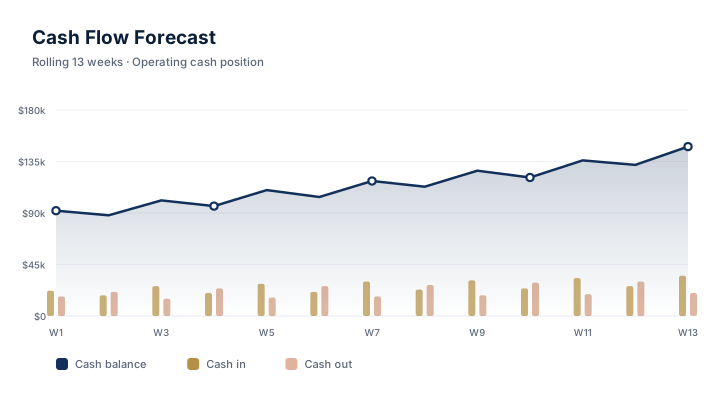
Profitable and short of cash is the most common condition in construction and real estate, and it is not a contradiction. Profit is recognised when earned; cash arrives when collected. The cash flow statement reconciles the two and shows you exactly where the money went — usually into receivables, inventory, or debt principal.
Gross margin — is the work priced correctly. Days sales outstanding — how long between invoicing and getting paid. Cash on hand in weeks of operating expense — how long you could operate if collections stopped. None of these require a finance background; all of them change decisions.
Disorganized records rarely announce themselves as a bookkeeping problem. They show up somewhere else, as a bigger bill or a worse outcome.
A free 30-minute review tells you which of these is costing you money right now.
Matching every transaction in your books against the bank or card statement for the same period, until the two agree to the cent. It is the check that proves the records reflect reality.
The list of categories your transactions are recorded into. A good one is short, stable, and organised around the decisions you make; a bad one grows by accident and is never used for anything.
The complete record of every transaction, in order, by account. Every report you read is a summary of the general ledger.
Cash basis records income when money arrives and expenses when money leaves. Accrual records them when earned or incurred. Accrual gives a truer picture of a job or a month; cash basis is simpler. Which basis you report on is a decision to make with your tax professional.
Attaching every cost — materials, labor, subcontractors, equipment — to the specific job it belongs to, so each job produces its own margin rather than disappearing into a company total.
A percentage of a construction contract withheld until the work is complete and accepted. It is earned revenue you have not collected yet, and it belongs in receivables, not written off.
Costs incurred and revenue earned on jobs that are underway but not finished. Tracking it is what stops a long job from making one month look terrible and the next look extraordinary.
What customers owe you, and what you owe vendors. Both belong on the Balance Sheet, and both are early warning systems — receivables climbing faster than revenue is a collections problem, not a growth story.
Revenue minus direct costs, before overhead. It answers whether the work itself is priced correctly, which is a different question from whether the business is profitable.
A holding account QuickBooks creates during setup. If it still has a balance months later, something from the initial setup was never resolved — it is one of the clearest signals that a file needs cleanup.
A schedule of units, tenants, lease terms, and billed rent. Useful only when it reconciles to the income recorded in the ledger for the same period.
A per-owner report of income collected, expenses paid, management fees, reserves, and the resulting distribution. It should be generated from the ledger, not assembled by hand.
Thirty minutes on your actual file will tell you more than any article. Bring your questions — you keep the recommendations either way.
Reach a real person — no chatbot, no queue.
Monday–Friday, 9:00 AM – 5:00 PM Pacific.